Interior
Tile work that starts with the waterproofing.
The layer behind the tile decides whether a shower is still dry in ten years. We build that layer first, and we build it to be inspected.
- Bonded waterproofing membranes, not just backer board
- Shower pans sloped to the drain before the tile goes on
- Movement joints at perimeters and changes of plane
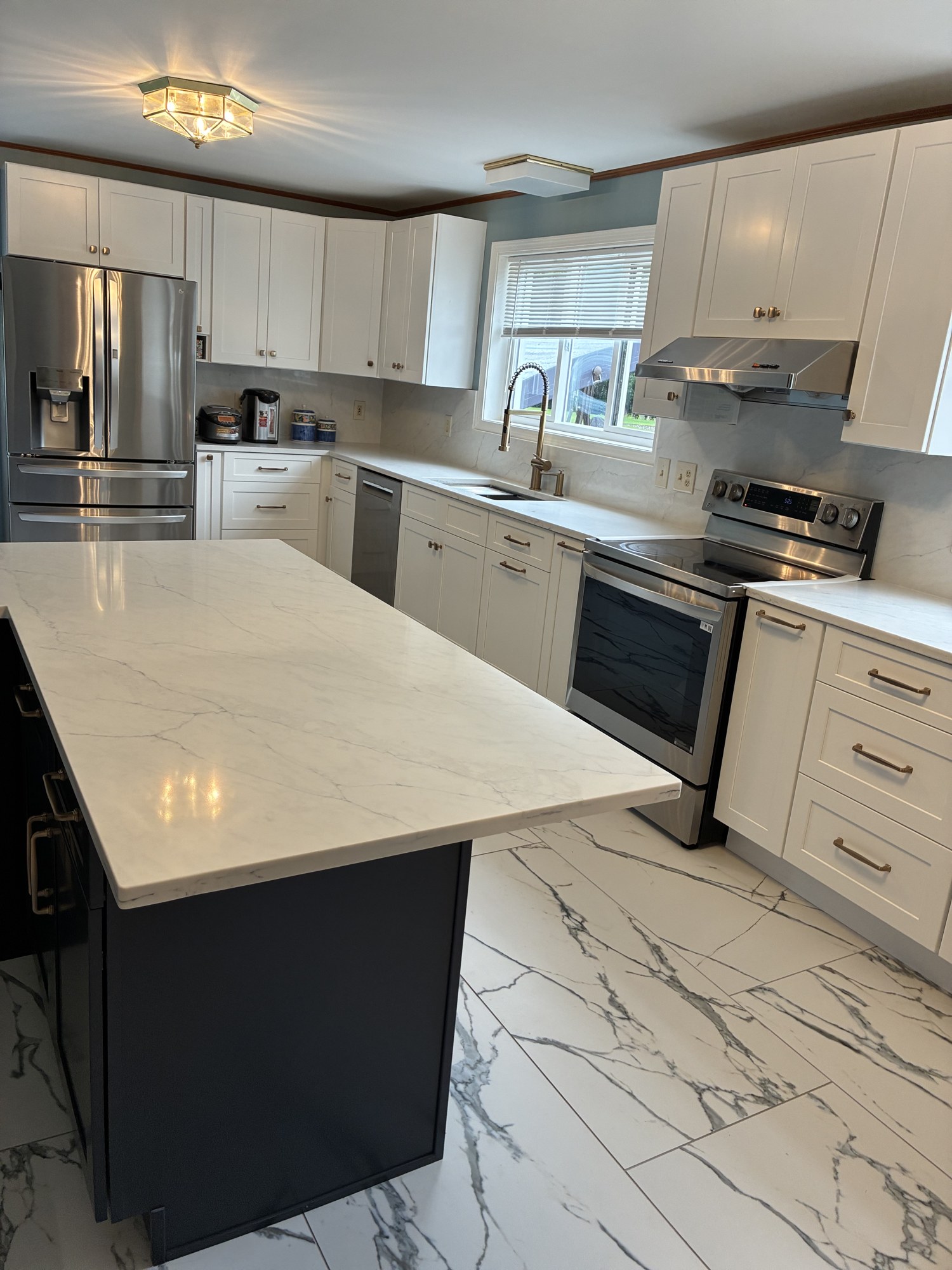
- Large-format tile set flat with leveling systems
- Electric floor heat installed under bathroom tile
What keeps a shower dry
Tile and grout are not waterproof: cement grout is porous by design, water moves through it, and the assembly behind it is supposed to handle that. When a shower leaks, the tile is almost always intact, and the failure is at a corner, a curb, a drain connection or a change of plane in the layer underneath.
The current standard is a bonded waterproof membrane, a sheet like Schluter-Kerdi, a foam board panel with sealed seams, or a liquid membrane rolled on in two coats, connected to a bonding-flange drain so the waterproof plane and the drain are one system. The older mud bed over a PVC liner still works when there is a pre-slope under the liner; built flat, which is common, the liner holds standing water inside the wall, and a musty twenty-year-old shower with no visible leak is usually exactly that.
- Bonded sheet membrane, foam board or liquid membrane over the substrate
- Preformed inside and outside corners rather than folded field material
- Bonding-flange drain tied directly into the membrane
- Pre-slope under any traditional mortar pan, at a minimum of a quarter inch per foot
- Pan flood tested before tile goes on, where the scope calls for it
Substrates, uncoupling and cracked floors
Cement backer board is dimensionally stable and unaffected by water, and it is not waterproof: water passes straight through it, so in a wet area it is a substrate for a membrane, not a substitute for one. Foam panels like Kerdi-Board are waterproof in themselves and usually the better buy on a shower with a bench, a niche and a curb, because the tricky geometry is where a sheet membrane takes the longest.
On floors, an uncoupling membrane like Schluter-Ditra separates the tile from a wood-framed subfloor that deflects and moves seasonally, which is where hairline cracks running through tiles in a straight line come from. If the joists are undersized or overspanned for tile, we say so before setting anything, because no membrane fixes a bouncy floor.
Layout, large format, and heated floors
Large-format tile shows every substrate variation as lippage, so it gets a flattened substrate, back-buttering with the right notch trowel, leveling clips while the mortar cures, and a third-offset running bond, which most large-format manufacturers now specify. Layout gets decided before the first tile: full tiles at the entry and the focal wall, sliver cuts eliminated, the niche sized to whole tiles, and every change of plane, inside corners and tile to tub, finished with flexible sealant rather than grout, because grout in a moving joint cracks.
Electric floor heat goes in while the floor is already open, with the sensor probe run between cable loops so a failure can be pulled and replaced, the dedicated circuit on the electrician's list before the walls close, and resistance readings taken before, during and after the set. Products like Ditra-Heat combine the uncoupling membrane and the heat cable in one layer.
Cabinet doors, flooring, tile and countertop samples are out at our showroom in Dover, NH. Visit the showroom
How it goes
How the job runs
01
Scope the substrate and the plumbing
We check floor deflection, wall plumb and square, and the existing substrate. Valve depth, drain type and blocking for benches, niches and glass all get settled before demo is finished.
02
Build the assembly
Substrate installed and flattened, shower pan pre-sloped, membrane bonded with preformed corners, drain tied into the waterproofing, penetrations sealed. Heat mat and sensor set if in scope.
03
Check the pan, then lay out
Where the scope calls for it, the pan is flood tested before anything is covered. Then we snap lines, dry-lay the critical rows and place the cuts where they read as intentional.
04
Set, grout, seal
Full mortar coverage, leveling clips on large formats, then grout after proper cure. Flexible sealant at every change of plane, sealing where the material calls for it, and a final wipe-down.
What we install
Materials and brands we work with
- Bonded sheet waterproofing membranes
- Foam backer panels
- Liquid-applied waterproofing
- Cement backer board
- Uncoupling membranes
- Uncoupling heat membranes and electric floor mats
- Bonding-flange and linear drains
- Porcelain, ceramic and natural stone
- Large-format and mosaic tile
- High-performance and epoxy grout
- Tile leveling systems
- Metal edge trim and tile profiles
Questions
Straight answers
- My shower does not leak, but it smells. What is going on?
- Most often a traditional mortar pan built without a pre-slope, so the PVC liner sits flat instead of draining to the weep holes and the mortar bed above it stays permanently saturated. Nothing shows on the ceiling below, but the smell is water that has been sitting inside the assembly for years. The fix is rebuilding the pan; nothing applied to the surface solves it.
- Can you just tile over my existing tile?
- Sometimes on a floor, if the existing tile is fully bonded and the added height does not break the transitions or the door swing. In a shower, essentially never, because it buries an unknown and likely failed waterproofing layer under two layers of tile, with weight and thickness the drain and valve were not set for. We tear showers to the studs.
- Is epoxy grout worth the extra cost?
- On a shower floor with small tile and a lot of joint, behind a range, or anywhere staining would bother you, yes: it is close to impervious and needs no sealing. It costs more, has a short working time that demands a careful installer, and is harder to repair or match later. A high-performance single-component grout gets most of the stain resistance with fewer drawbacks, and that is what we use most.
- Why is my tile cracking in a straight line across the floor?
- A straight run of cracks means substrate movement telegraphing through: a seam between subfloor panels, a joist deflecting under load, or no uncoupling layer or movement joint. The repair is taking up the tile, addressing the deflection if that is the cause, and rebuilding with an uncoupling membrane and properly placed movement joints. Grouting the cracks buys a few months.
- Do I need heated floors, or is that a luxury?
- Optional, and also the upgrade people mention unprompted years later, because a tile floor over an uninsulated first floor in a New Hampshire winter is genuinely cold. It warms the surface rather than the room. Decide before the electrician roughs the bathroom, because retrofitting it means taking up the floor.
Get a real number on your tile work
Send us the details and we'll get you a written estimate, without a sales visit you have to sit through.
Showroom in Dover, NH · Serving the New Hampshire Seacoast and southern Maine